The reader that remembers what you struggled with
Drop in an EPUB or an FB2 — or photograph printed pages. Read the way you would on a Kindle. An unfamiliar word is saved together with the sentence from your own book, and comes back as a card just before you would forget it.
Your own books
EPUB, FB2, OPDS catalogues, photos and PDFs. Nothing is sold inside — you bring your own.
A vocabulary from your book
Not Anki, where words are typed in by hand, and not somebody else’s examples: the card keeps the sentence you met the word in.
Read together
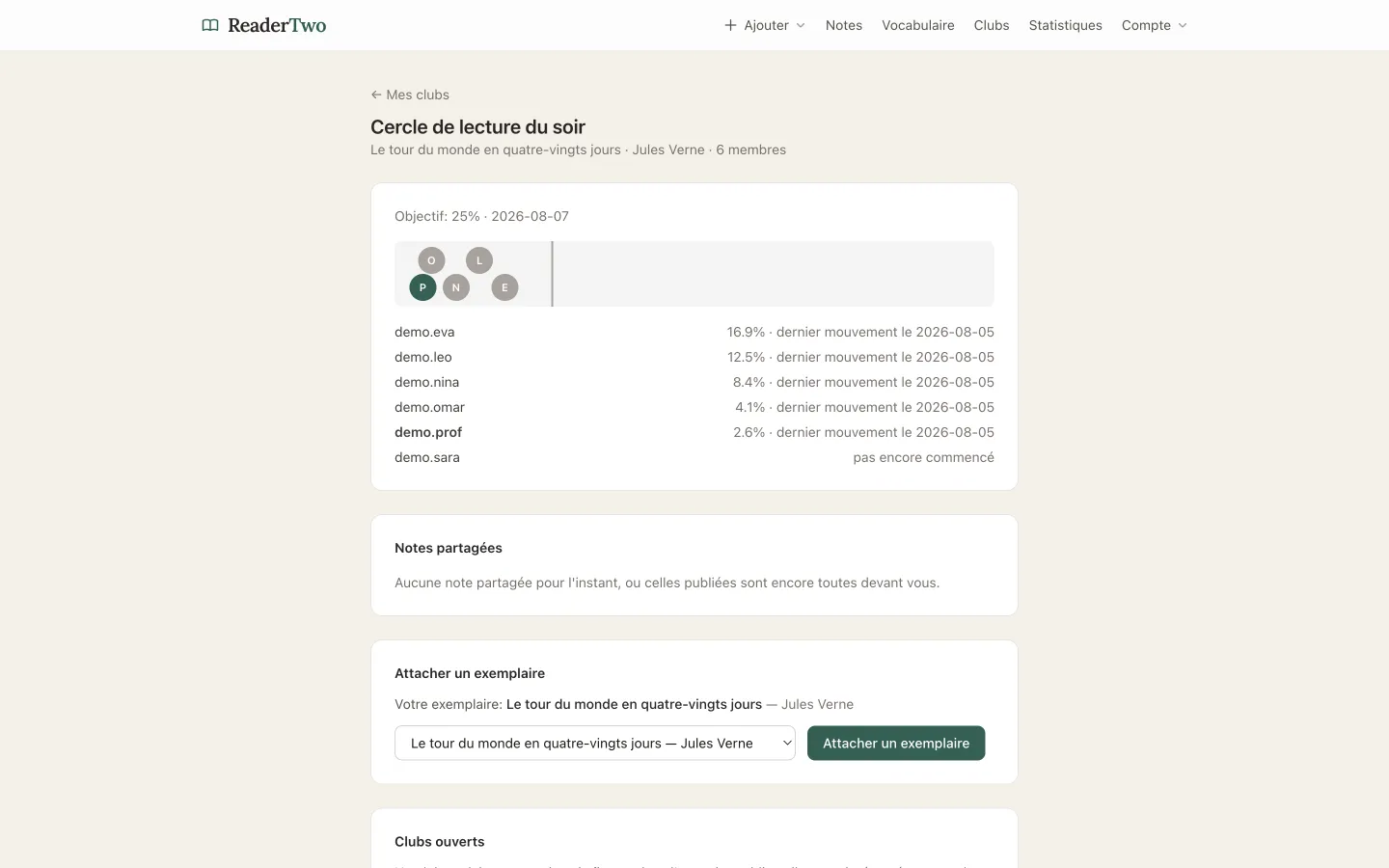
A club shares a reading, not files. Everyone keeps their own copy — a different edition, or even a translation.
I read for myself
Everything you need to read properly
Bring anything
EPUB, FB2 and OPDS catalogues. Photographs of pages and PDFs become a book through text recognition — a textbook that only exists on paper can be read too.
A reader, not a web page
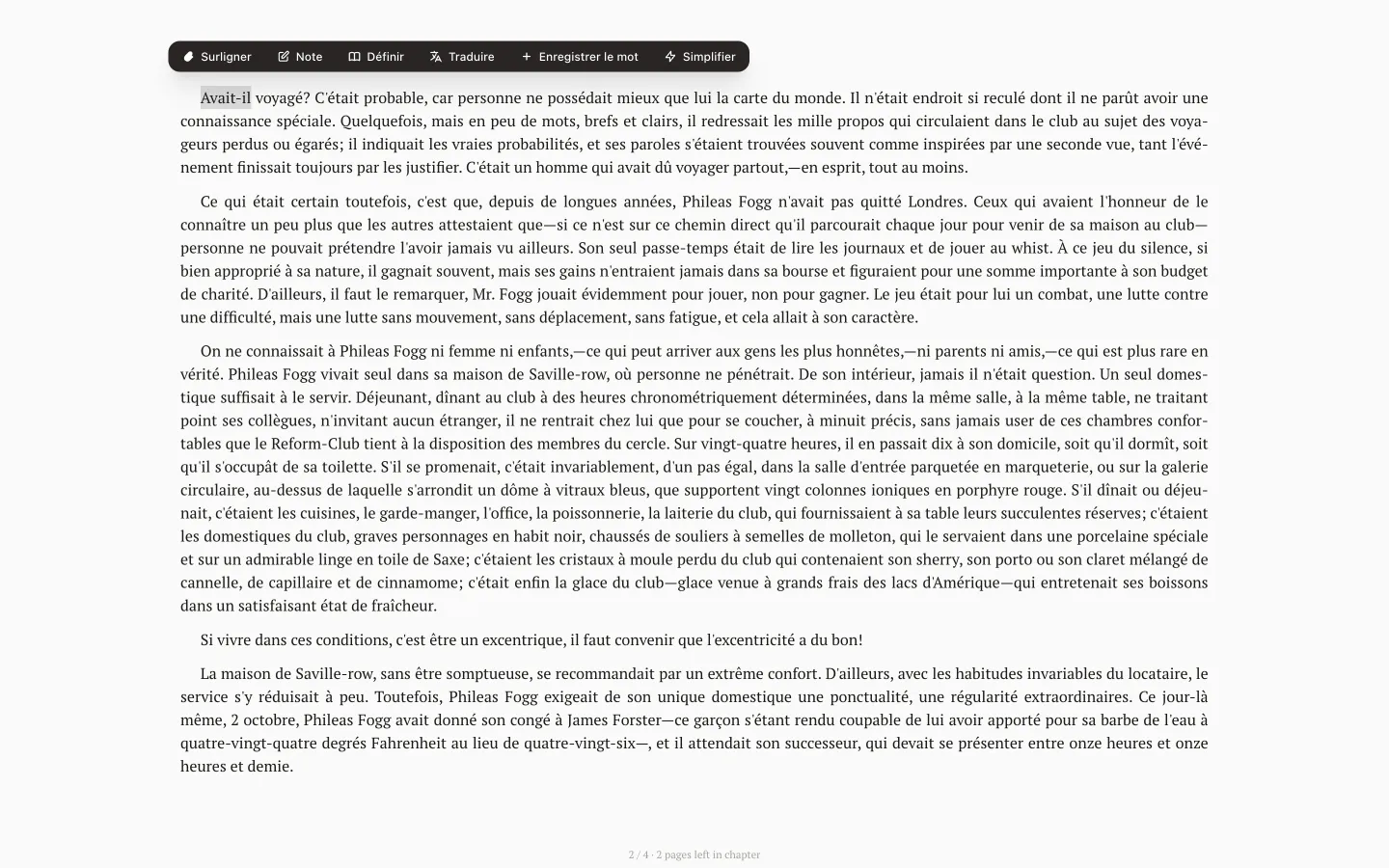
Paged or scrolling, eight themes plus your own colours, margins and fonts. Read-aloud with the current sentence highlighted and a sleep timer. Auto-scroll. Footnotes at the bottom or in a popup. Search inside the book. On a phone the selection stretches with handles, the way it does on a Kindle.
A word becomes a card
Select it, get a translation or a dictionary entry, save it. Then spaced repetition: the word returns just before you would forget it, and turns into “known” once the interval passes three weeks.
When a paragraph will not yield
“Simplify” rewrites it more plainly without changing what it says. “Translate” gives you the whole paragraph, read in context — a tap in scroll mode, a selection in paged mode. For the chapter: comprehension questions and a CEFR level.
Progress that does not punish
Minutes read, a daily goal, a heat map of the year and an estimate of what is left. The day streak forgives one miss: reading is a pleasure rather than an obligation, and one family Saturday should not wipe out two months.
I teach
A class you can see whole
A school in a minute
Create the organization, open a group, hand out an invite code or link. Roles: student, teacher, administrator.
The class library
A school book is visible to the whole group, but only its owner can edit or delete it: shared read access never grants the right to write.
Assignments and a dashboard
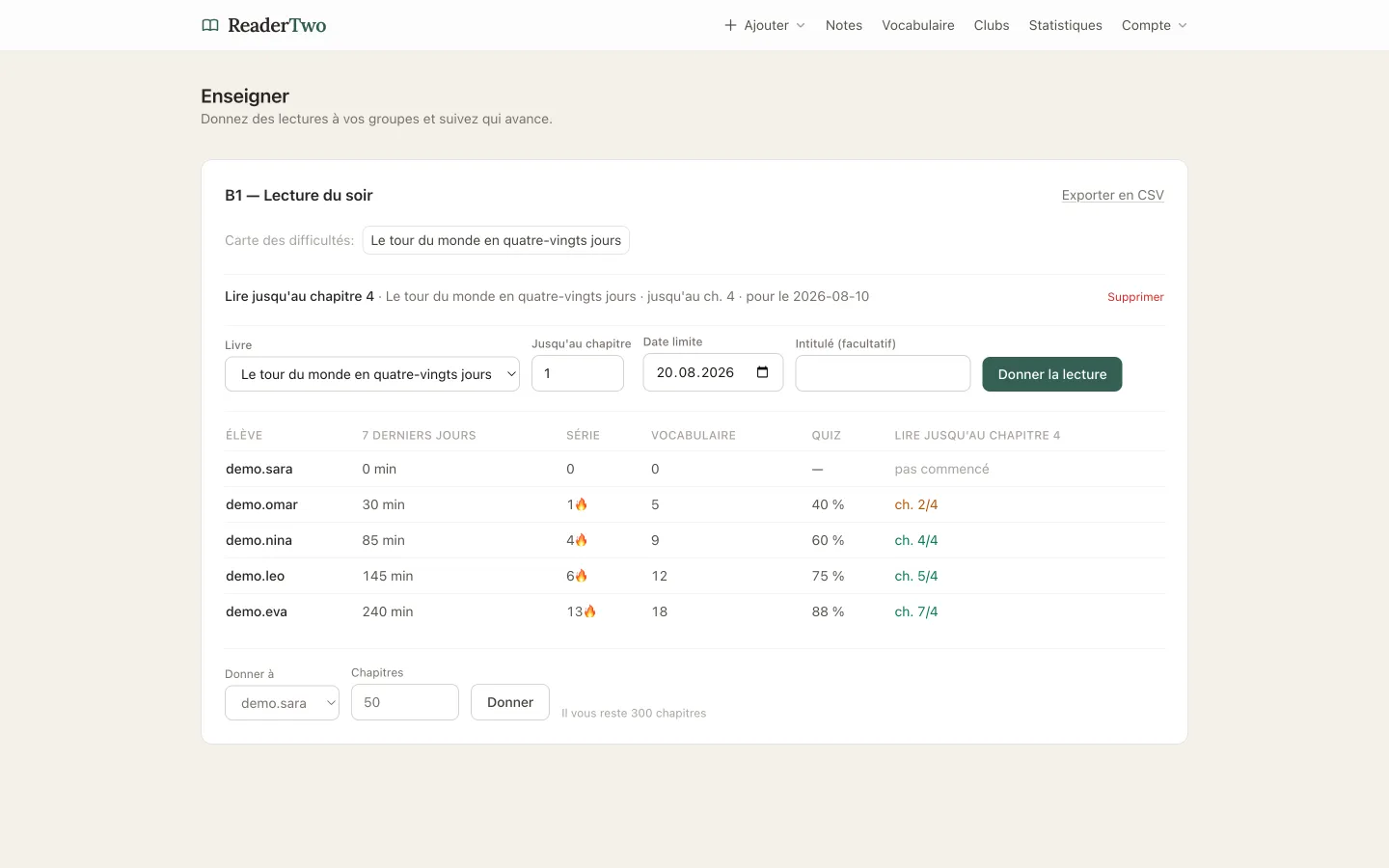
An assignment reads “up to chapter N by this date”. The table shows minutes this week, the day streak, vocabulary size, quiz percentage and progress on the assignment. It sorts worst-first: whoever has not started rises to the top on its own. The CSV export opens in Excel with no import wizard.
The friction map
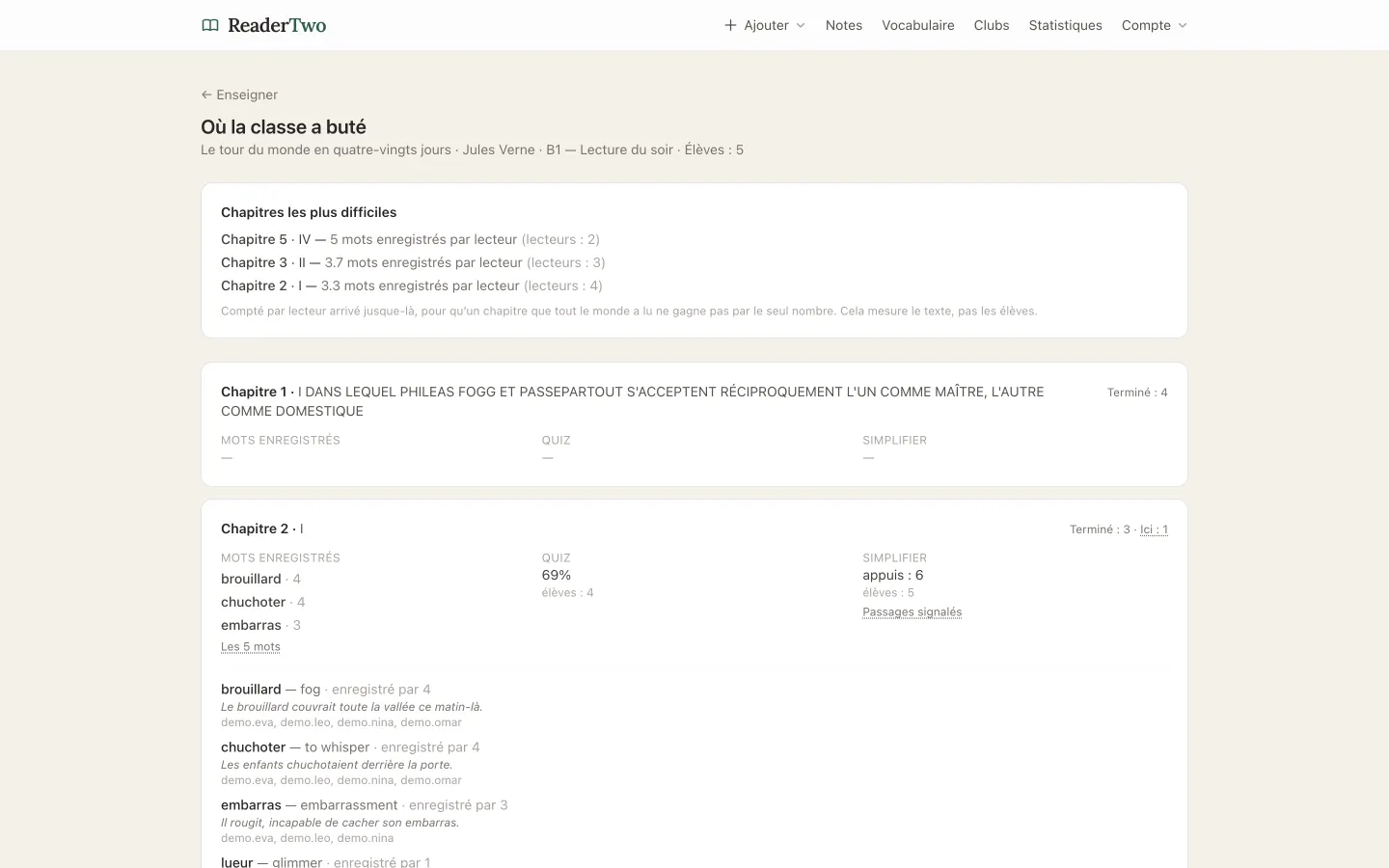
The dashboard answers “who is behind”. The map answers “what exactly was hard”: chapter by chapter, which words the class saved and the sentences they came from, the quiz average, how often the text was asked to be simplified and how often to be translated — and which phrases. Those are two different complaints: simplifying is about the language being hard, translating is about the meaning not landing. An ordinary reader collects all of this already and shows it to nobody.
Children’s privacy is not a checkbox
Names are off the screen by default, only counts; a click reveals a name. An invite link shows the book and the number of members, never the list: a link travels further than its sender intends, and a school club’s roster is a list of children. A school club cannot be published to the public directory at all.
Everyone keeps their own first language
The language of the interface and the language you translate into are separate settings. A school in France runs in French while its Moroccan pupil gets Arabic and its Ukrainian pupil gets Ukrainian. Thirteen languages, each listed in its own script: العربية, Українська, 中文.
What we are upfront about
- The AI layer — simplifying and translating a passage, chapter questions, difficulty level — is switched on with a provider key. Without it the reader, the vocabulary trainer and the whole school side work in full.
- The open club directory is not moderated — which is exactly why a school club cannot appear in it.
- Removing a club from the directory does not revoke a link that has already circulated. To close that door the link has to be changed; the button is on the club page.
See it live
A demo school with real data: a group, an assignment, five students with different reading histories. Demos are given in person, so questions about privacy and rollout get answered on the spot.
Start with a single book
Interface in French, English and Russian. Each reader picks their first language separately — translations and vocabulary arrive in it. Installs on a phone like an app and works offline.